

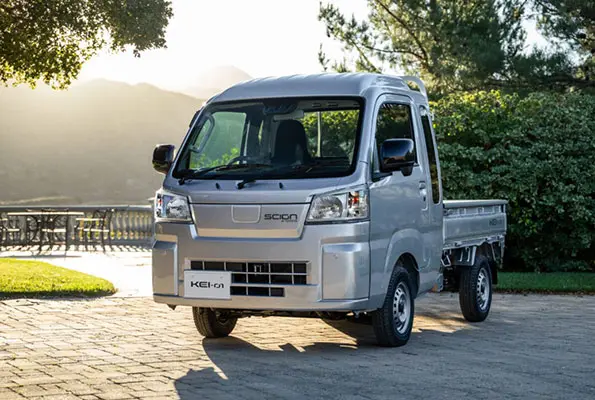
After dominating the home market, Toyota Motor will introduce its ultra-compact KEI-01 mini trucks to the United States in the second half of 2027, initially targeting fleet customers in a limited rollout following “encouragement” from President Donald Trump.
As per the Japanese automaker, the vehicles would be assembled at its Indiana plant, with the project involving a USD 34 million investment and the creation of 50 jobs in the world’s largest economy.
The KEI-01 is powered by a 660 cc three-cylinder engine and features four-wheel drive.
Measuring just over 11 feet in length and under five feet in width, the right-hand-drive truck has a maximum speed of 25 miles per hour.
Toyota said the vehicle is designed to meet US federal low-speed vehicle safety requirements.
While the KEI-01 mini truck’s initial distribution will focus on commercial and institutional fleet operators rather than individual buyers, Toyota may consider limited retail sales later.
Potential customers may also include small businesses, delivery operators, farmers, ranchers, universities, municipalities, and corporate campuses.
Kei vehicles are a major segment of Japan’s automotive market, accounting for roughly one-third of the country’s 3.7 million new car sales in 2025. These compact vehicles are not currently manufactured by US automakers.
Trump has expressed interest in bringing kei cars to American roads but has stressed that they should be assembled domestically.
Separately, Toyota also announced plans to relaunch its Scion brand in the US market.
Toyota has already lifted its annual outlook, with robust sales of hybrid vehicles helping the Japanese automobile giant defy an industry downtrend.
Apart from announcing its revised annual outlook, Toyota also informed the media about undertaking an USD 89 billion plan to boost shareholder returns.
Also benefiting from a weaker yen and lower US tariffs that helped offset a slide in sales in China, Toyota said it now expects operating profit of 3.9 trillion yen (USD 24.6 billion) for the year ending March, up 15% from an earlier forecast.
The automaker also posted a forecast-beating 34% climb in operating income for the July-September quarter.
Toyota has benefited from its focus on petrol-electric hybrids as fuel costs have surged in the wake of the Iran war, even as it faces considerable headwinds in the form of competition from Chinese EV companies.
Unlike other traditional car companies that heavily invested in electric vehicles and subsequently had to write down billions of dollars due to declining demand, Toyota has primarily concentrated on advancing the hybrid technology it popularised with the Prius decades ago.
The strategy has been key to its ability to defend market share in its main market, the United States, despite Chinese players threatening its business prospects elsewhere, especially in Europe and Southeast Asia.
Image Courtesy: Toyota