

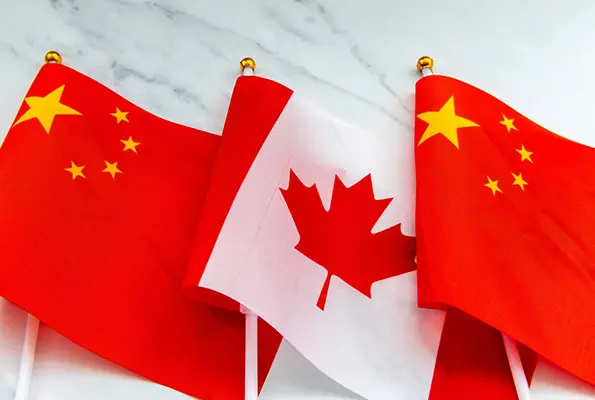
China has agreed to cut tariffs on further Canadian exports, including meat and seafood, in a major boost to the efforts of Mark Carney’s administration to shore up bilateral trade ties as Ottawa seeks to diversify its export markets and reduce its reliance on the United States.
Carney’s office announced the deal Tuesday, following his meeting with Chinese President Xi Jinping ahead of the Asia Pacific Economic Cooperation (APEC) summit in Shenzhen.
The Canadian prime minister described the improving relationship between the two countries as offering “greater predictability and stability.”
Under the arrangement, Beijing will provide additional tariff relief on approximately CUSD 400 million (USD 280 million) worth of Canadian exports, including frozen meat cuts, fish and seafood.
The agreement extends and expands a preliminary arrangement designed to improve access to the Chinese market for Canadian farmers and seafood producers.
In return, Canada has agreed to extend by two years its existing tariff remission measures for certain Chinese steel and aluminium products. These measures are currently scheduled to expire at the end of 2026.
Beijing subsequently confirmed the broad terms of the arrangement in a statement issued by its commerce ministry.
The latest agreement forms part of Carney’s broader economic strategy to diversify Canada’s international trade relationships and reduce its heavy reliance on the US market.
Washington has imposed substantial tariffs on several Canadian products, adding pressure on Ottawa to explore alternative export destinations.
After his meeting with Xi, Carney stated that Canada was already ahead of schedule in its goal of increasing exports to China by 50% by the end of the decade.
The two leaders have now met three times since Carney became the prime minister, including discussions on the sidelines of 2025’s APEC summit in South Korea.
Xi said exchanges and cooperation between the two countries had fully resumed since they agreed in January to advance their strategic partnership.
According to China’s official Xinhua news agency, the Chinese president outlined four proposals for strengthening bilateral relations. These include improving mutual understanding of each country’s development priorities, expanding cooperation in trade, energy, agriculture and finance, and exploring opportunities in green technology, digital industries and e-commerce.
Xi also called for stronger cultural and people-to-people exchanges and greater cooperation in supporting the multilateral trading system.
“Stronger communication and cooperation between China and Canada will benefit not only our two countries but also Asia-Pacific and the world,” he told Carney.
The latest tariff agreement builds on several trade measures introduced following Carney’s January visit to China.
Beijing previously reduced tariffs on Canadian canola seed and extended tariff relief for canola meal, lobsters, crabs and peas for another two years.
Energy trade has also gained momentum. Shipments of Canadian crude oil to China increased approximately 37% in 2026, according to a Reuters calculation based on LSEG data.
Meanwhile, Chinese automakers are preparing to expand their presence in Canada. BYD, Geely and Chery have taken steps to enter the market after Ottawa approved annual imports of 49,000 Chinese-made vehicles at a tariff rate of 6.1%.
The quota is scheduled to increase to 70,000 vehicles over five years.
Financial cooperation is another part of the improving relationship. China’s Finance Ministry said both countries welcomed steps by their central banks to implement a bilateral local currency swap agreement.
They also encouraged qualified Canadian financial institutions to issue Panda bonds, which are yuan-denominated securities sold in China’s domestic market.
Canada’s efforts to strengthen economic ties with China are unfolding alongside continued uncertainty over its trade relationship with the United States.
Carney said last Saturday that he had held lengthy and substantive discussions with US President Donald Trump, adding that both countries were making progress towards a trade agreement. But the two sides have yet to reach a deal.
US Treasury Secretary Scott Bessent expressed optimism about the prospects of securing trade agreements with both Canada and Mexico.
“I am optimistic that we can get trade deals with Canada and Mexico,” Bessent told CNBC on Friday, without providing further details.
His comments came amid renewed tariff threats from Trump against Mexico. The US president warned that he could double tariffs on Mexican goods if the country failed to stop more than 1,000 migrants travelling north towards the US.
The warning has added another layer of uncertainty to negotiations between Washington and its two North American trading partners. The discussions have continued after Trump chose in July not to extend the US-Mexico-Canada trade pact.