

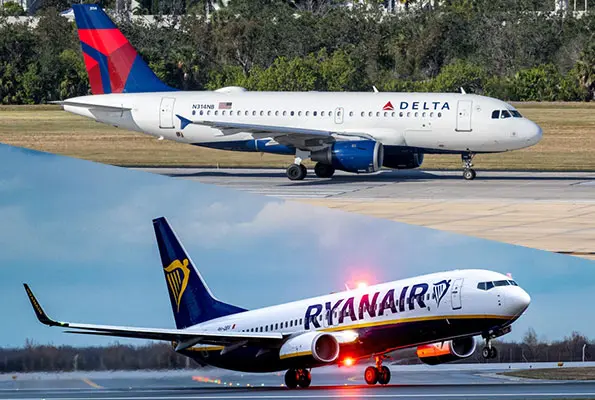
Elevated jet fuel price has continued to dominate the global aviation discourse, with Delta Air Lines cutting its annual profit forecast by nearly a quarter at the midpoint on Friday as energy costs overwhelm strong travel demand and higher ticket prices.
Not only Delta, but the broader US aviation industry is facing the dilemma of whether to make passengers absorb further fare increases if fuel prices remain elevated.
While most American airlines have already raised fares substantially since the beginning of the Iran war, analysts don’t see the trend ending anytime soon, apart from foreshadowing rate increases that test travelers’ willingness to keep spending.
Delta expects its annual fuel bill to rise by roughly USD 6 billion from 2025.
The carrier’s third-quarter fuel expense jumped 62% year-on-year to USD 4.1 billion, more than USD 500 million above what it anticipated in July.
“All of it’s fuel,” Delta Chief Financial Officer Erik Snell told reporters when asked what drove the forecast cut, citing increases in both crude oil and refined jet fuel prices since the summer.
Delta now expects adjusted annual earnings of USD 5.10 to USD 5.60 a share, down from the USD 6.50 to USD 7.50 it forecast in July.
The new midpoint of USD 5.35, however, remains below analysts’ average estimate of USD 5.46, according to LSEG.
Delta’s Q3 adjusted earnings of USD 1.72 a share narrowly missed analysts’ (polled by LSEG) average estimate of USD 1.76.
The carrier’s adjusted operating margin fell to 9.4% from 11.1%.
United Airlines, American Airlines, and Southwest Airlines will be reporting their financials by this month’s end.
The fuel pain has been tremendous for the American carriers since February.
As per the Bureau of Transportation Statistics, these businesses spent USD 42.9 billion on fuel for scheduled flights in the first eight months of 2026, nearly USD 13.2 billion more than a year earlier.
While the travel demand has remained strong, airlines have leveraged the limited growth in seats to pass higher fuel costs on to passengers.
US airline fares rose an average of about 25% from a year earlier in the five months through August, as per the Bureau of Labor Statistics’ consumer price index.
Analysts will now be excited for the fourth quarter, where, despite elevated fuel prices, industry will proceed with its planned capacity growth.
Deutsche Bank analysts expect the industry to recover a smaller share of higher fuel costs through revenue measures in the fourth quarter.
However, analysts do not anticipate a full recovery until early 2027.
Delta, however, said travel demand remained strong.
Almost 60% of the carrier’s fourth-quarter flights are already booked, and as per Snell, the business expects revenue growth of about 20% from a year ago.
Delta also has an advantage over other major US airlines: its ownership of a refinery outside Philadelphia that Snell expects to generate profit worth USD 700 million this year.
“We have a refinery that gives us an offset, a partial offset to fuel prices that no one else does,” he said.
Acquired in 2012, the Monroe refinery processes crude oil into jet fuel and other products. Delta still pays market prices for fuel transferred to its airline operations but retains the refining profit within the company.
Delta receives financial protection from the Monroe refinery whenever the gap between crude and refined fuel prices widens, unlike its industry rivals that face increased costs when purchasing from outside suppliers.
However, the facility can only partly cushion the impact of higher fuel prices.
“Even with a projected refinery benefit of 40 cents a gallon, Delta expects its fuel cost to rise to USD 4.25 a gallon in the fourth quarter from USD 3.61 in the third,” Snell said.
While stating that the fuel prices will remain elevated for now, the senior official concluded, “Ultimately, fuel will come down. When that is, we’re not exactly sure.”
In fact, as per Ryanair Group CEO Michael O’Leary, airlines, especially the European ones, could face more than another year of elevated fuel costs and higher fares.
He sees the knock-on effect spilling into 2028 as well.
O’Leary had a more profound understanding of the industry mathematics, as he told the reporters at an Airlines for Europe (A4E) press conference that jet fuel is currently about 50% pricier than it was pre-war and is likely to remain at those levels for the next 12 to 18 months.
While he doesn’t see the fuel’s supply to run out anytime soon, it’s the elevated price that would continue to pain the carriers, irrespective of their size.
“We are all facing an enormous cost challenge next year. There is no question over the availability of jet fuel in Europe this winter, or frankly, into next summer,” O’Leary said further.
While O’Leary expects fare increases to continue in the coming months, he also observes that carriers are significantly less hedged against jet fuel costs as they move into 2027.
“The airlines cannot survive unless they pass on these insanely higher fuel costs in the form of higher offers, and the customers will have to pay,” O’Leary told journalists on the sidelines of the press conference, adding later that the situation was already a “full-blown crisis.”